“Bob Hebeisen just reordered Viagra®”… and other Facebook marketing campaigns you should never see

By Bob Hebeisen

The other day I was reading an article on Ad Age Digital about Facebook marketing. It was a recap of various case studies of successful Facebook marketing campaigns including Amazon, Apple, Netflix, Forever21, eBay, MTV, TripAdvisor, Ticketmaster, and Major League Baseball.

At the end of the article, the author insists…

“Any way you look at it, the future of nearly every business
is intimately entwined with Facebook…”

This is a crazy statement. Come on, gotta stop the hype. Facebook marketing is a good tactic for many — but not all — consumer brands. And it is not an efficient or effective tactic for most B2B brands.

Are the fish inclined to take your bait?

There is an old adage about marketing and sales: “fish where the fish are.” It means your marketing and sales efforts should be focused on media that can deliver your target market. It wouldn’t make much sense to go fishing in a pond where all the fish have been removed, it would not yield positive results. Likewise, if you spend your time executing marketing campaigns to lists and media devoid of your target audience then you will experience very poor results.

But I think a more apt adage would be to “fish where the fish are inclined to take your bait.” I know that is not as catchy as the original phrase, but let me explain. You could fish all day long in a lake full of fish, but if the fish are for some reason not inclined to take your bait then you will not have good results.

That’s what I think is the big problem with Facebook marketing for many brands. There is little doubt that Facebook can deliver your target market. We all know the stats:

However, there is one sobering statistic for B2B marketing:

But that’s not the biggest problem.  For many brands (some consumer and most B2B) people are just not willing to engage on Facebook. The “fish” are present, but they are not inclined to take your bait.

Examples of Facebook marketing campaigns you should never see:

#1. Bob Hebeisen shared the Groupon™ “25% discount on United Site Services Portable Toilet Rentals” — Sure, event planners place a high value on reliable service vendors. But the minutia of our work lives is often too technical or mundane to share on Facebook because it would be excruciatingly boring for our friends and family. United Site Services does not have a Facebook page.  As a B2B marketer for the software company PTC, I “liked” Facebook campaigns that my own company was running, and shared technical videos and published case studies about CAD software on Facebook. I can tell you now that it bored the heck out of 99% of my family and friends.  Even the design engineers who were included in our target market joined our Facebook campaigns in very small numbers and engaged very infrequently.  Marketing bandwidth would have been better spent elsewhere.

  • Social Media that makes sense: United Site Services has built some basic interactive components into their own website: a sizing and configuration guide that helps event planners get the right number and type of units based on their audience needs.  They could host a blog about all sorts of event management topics to engage their buyers.  They could build a stronger presence on LinkedIn and participate in LinkedIn discussion groups for event planning.

#2. Bob Hebeisen’s APC Back-UPS® ES 550VA uninterruptible power supply saved the day this morning when the power spiked while performing the month-end financial close — It might be true, but it is not really something you would type into your Facebook status update. APC does not have a Facebook page.

  • Social Media that makes sense: APC supports their user community with a robust set of discussion forums.  This makes a lot more sense than Facebook for a technical buyer, and for a product you hope you never have to rely on.

#3. Bob Hebeisen likes Joshua Spirn & Associates bankruptcy attorneys — The brands you are affiliated with in your work life may represent highly confidential activities.  Your company would probably not appreciate it if you were publicly “liking” a bankruptcy attorney on Facebook for all the world to see (and in fact it might represent an SEC violation if you work for a public company).  Joshua Spirn & Associates *does* have a Facebook page, and it is pretty well populated with status updates.  But only one person has clicked the “like” button to receive the attorney’s status updates in their feed, so I would question whether maintaining a Facebook presence is an effective use of their time.

  • Social Media that makes sense: Joshua Spirn Associates has excellent search engine ranking and they have 24×7 live chat on their website.  That probably contributes greatly to new business.  They also maintain a weekly blog.  This is a good idea, but there is no real opinion sharing on the blog, it is more of a running list of local companies who have declared bankruptcy, so there is little or no commenting or other audience interaction.  They would probably benefit from actively seeking endorsements on services like Yelp (only 1 endorsement) where the identity of the endorser is kept somewhat anonymous.  They could also explore LinkedIn (they do not have a company profile on LinkedIn, and there are some discussion groups dedicated to bankruptcy law they could participate in).

#4. Bob Hebeisen just reordered Viagra® — Unless you are Bob Dole, Pele, or another celebrity endorser of Viagra, you are probably not interested in broadcasting your affiliation with that brand — even though you might be a devoted and grateful user.  Viagra does not have a Facebook page.

  • Social Media that makes sense: I think Viral Video would be a great social media element for Viagra’s marketing strategy.  But, surprisingly, it is almost impossible to find any of Viagra’s celebrity endorsement commercials on YouTube.  So it would seem that not only have they opted NOT to upload and distribute these videos on YouTube themselves, but they actively police other individuals from uploading them.  Viagra does have a YouTube channel but it is currently devoted to informing people about pharmaceutical piracy.  Viagra apparently has exactly zero sense of humor about erectile dysfunction, and maybe that is the best tone for them to set from a business standpoint.

I’m not saying there are no uses for Facebook marketing in the B2B world. There are some business products that are so pervasive and used horizontally across so many different industries and job functions that Facebook is a good medium. For example, the Microsoft Excel Facebook page offers tips and techniques and moderated peer support to its 81K+ friends.  Frankly, users might be better served finding answers on the Microsoft Excel Support Site or the MSDN Forum, but Facebook is much more approachable for most non-technical users.  Microsoft’s time maintaining the MS Excel Facebook page is probably time well spent.

It’s about context

The reason Facebook doesn’t work for the majority of B2B brands is not that the audience is absent.  It is not that you can’t select the right people through profile data or relevant “likes”.  It is not because of any mechanical problems with Facebook as a medium — it is a great platform for publishing content and enabling people to interact with it (likes, comments, shares).  It is not because the results cannot be measured — with appropriate campaign discipline it is just as easy to track Facebook campaign effectiveness as any other web or email campaign.

The problem with Facebook for B2B marketing is purely related to context — it is a place where people gather for non-work related fun.  Even if you are Facebook friends with your work colleagues, you probably do not interact with them on Facebook *about work matters*.  It is not the place where people are looking for work-related product information or brand interaction.

Posted in Blog, Community Site, Facebook, LinkedIn, Social Media, Viral Video, Yelp | 2 Comments

Tapping Internet Memes for Viral Videos*

(*at least I hope it goes viral!)

By Bob Hebeisen

For the past few months I have been contracting at Alpha Software Corporation. In business since 1982, Alpha is a real bootstrap organization with lean, highly productive permanent staff, and they plug in contractors and service providers to add capacity.

Well, the bootstrapping must have rubbed off on me a little bit because while I was working on a landing page optimization project, I found myself playing around with a meme video, hoping it would go viral.

Why a Meme?
When we first started talking about viral videos, someone tossed around some ideas about funny and intriguing video concepts. But I think it is really hard to come up with something funny enough to go viral. And then it is also difficult and costly to get it produced with high enough quality to pay off the concept (and also to reflect positively on your brand). And finally, once you get it produced you need to get enough exposure to feed the chain reaction that makes it go viral. If you mess up on any of those variables, then you’ve wasted a lot of time and money on a flop.
The rules are different when you are talking about Internet memes:
  • Internet memes are already funny. They are, by definition, a running joke.
  • Internet memes typically have low production value and can be “hacked” with technology that is free to download or already on your computer.
  • Internet memes already have an audience because people are familiar with previous versions of them.
And so I wound up creating this viral (I hope) video “MS Access 2010 Dog Tease.” It was surprisingly easy to create, here are the steps:

1. Find a meme that fits your brand and your message
After a little bit of brainstorming, we decided to do a version of the Dog Tease meme. The original Ultimate Dog Tease video is a viral blockbuster with over 65 million views on YouTube. If you search YouTube for “dog tease” you will see it has been modified, copied, and responded to hundreds of times for comic and promotional effect.
Here’s why the Dog Tease meme made sense for Alpha Software:
  • Alpha Software Corporation is dog crazy. Specifically, Richard Rabins, the Co-Chairman, is dog crazy. He always has been. When I worked there back in the ’90s, Richard instituted a policy where any employee could bring their dog to work at any time (the woman I shared an office with had a 140 lb. English Mastiff named Jagger she would regularly bring to work). More evidence: earlier this year, Alpha issued a press release announcing that Richard’s dog Clifton had joined Alpha as “Director of Sniff-Testing.”
  • The theme of the Dog Tease meme is disappointment. The dog’s hopes get built up when the man starts talking about food, only to be dashed when the man announces that he ate the food himself, and then gave it to the cat. Alpha’s brand is all about picking up off the floor the disappointed customers of other database software. So we did a version of the dog tease video that starts with a disappointed dog but then gives him renewed hope.
When we started discussing using a meme, Richard suggested the Dog Tease meme, and it was a perfect choice.

2. Get the source video
Sure, you can find the video on YouTube. But you need to get the video file *onto your hard drive* if you want to modify it and then output your own video. Mashable published a list of applications you can use to download YouTube videos to your computer. I ended up using Easy YouTube Video Downloader, which is a plug-in for FireFox that adds a button to the YouTube interface and allows you to download any YouTube video as a MP4 file, it couldn’t have been easier. Please note this disclaimer from the Mashable article:
…downloading personal copies of YouTube videos is not supported by the YouTube Terms of Service, which states: “You may access User Submissions for your information and personal use solely as intended through the provided functionality of the YouTube Website. You shall not copy or download any User Submission unless you see a “download” or similar link displayed by YouTube on the YouTube Website for that User Submission.”

3. Script it
The hardest part of the whole project was developing the script for the meme video. It wasn’t difficult, just tedious. Since you are going to re-use the existing video and just replace the audio, the first thing you need to do is map out the script of the original video, and then fit your revised script into the same cadence so the video and your new audio match up and look natural. You can see from the screen shot below the way I used MS Excel to map out the original script on a timeline and then draft the replacement script to fit.

You can download the spreadsheet document I used for scriptingto make it easy if you decide to do a video of your own.


4. Produce it
This is surprisingly easy, even for someone like me with next to zero video production experience. The means for doing it are readily available, here’s what I used:
  • The standard microphone from my laptop computer
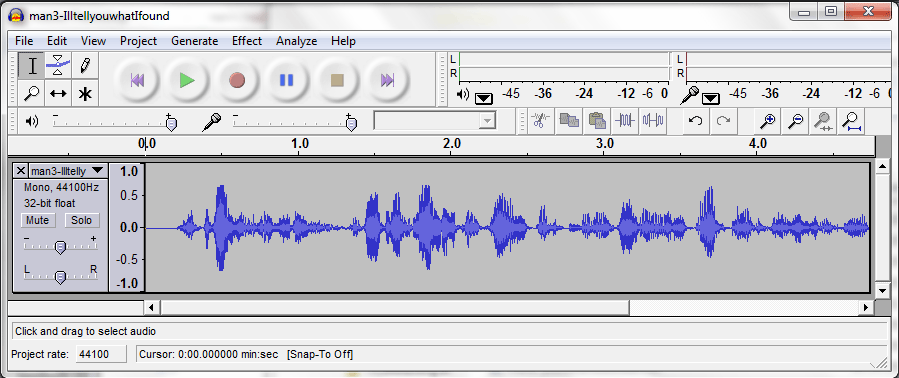
  • Audacity, an opensource freeware audio recording and processing software
  • Microsoft Windows Live Movie Maker (which ships with Windows 7) for mixing the new audio track to the video and outputting the new video
There was one thing I was unable to do with Microsoft Windows Live Movie Maker. The original dog tease video was only one minute and six seconds long. That’s not enough time to get much of a marketing message across to your audience. So I came up with the idea that we could double the length of the video simply by running it forward and then in reverse, like a mirror image. Since the video footage is just a dog shifting around, wagging its tail, and making funny faces, it actually looks pretty natural when you run the footage backwards, nobody who I’ve shown it to has even noticed it until I point it out. Microsoft Windows Live Movie Maker does not support the ability to run your video in reverse, so I had a friend with Final Cut Pro on the Mac who did it for me in about 30 seconds. Here’s the doubled video file if you want it.
  • First I recorded the dog’s voiceover and dropped the audio clips into Microsoft Live MovieMaker. Audacity lets you easily record the audio, trim dead spots from the beginning and end of your recording and smooth over any hot spots, and then save them as .WAV files. MovieMaker lets you import audio, position it on the timeline just right, and mix it with the original video. Record each vocal outburst as a separate file, so you will end up with around 15 little audio files for the dog.
  • Next I output the new video with just the dog’s voiceover. Why did I do this? Because MovieMaker does not have multi-track capabilities for audio, so any overlapping of the dog’s voiceover with the man’s voiceover could not be accommodated. So I output the video with just the dog’s voiceover and then I started a new MovieMaker project with that interim video to add the man’s voiceover.
  • Then I recorded the man’s voicover and dropped the audio clips into MovieMaker.(Again, I recorded each vocal outburst as a separate file and I had around 15 little .WAV files for the man’s voiceover.)I imported them into MovieMaker and positioned them just right on the timeline.
  • I added credits and a call-to-action (CTA) to the end. MovieMaker makes it easy to add title screens, credits, and captions to your videos, and to use basic animation techniques like wipes, fades, scrolls, etc. The CTA is to download the Alpha Five free trial.
  • Finally, I output the finished video. When outputting the video from MovieMaker, I just used the recommended settings for the output file and I wound up with about a 40MB .WMV file and the A/V quality is totally fine.

5. Post it
This is pretty straightforward. We posted it on YouTube and Vimeo, and might post it on a few other video sharing sites.
However, before you upload the video, take some time to think about how you can maximize the SEO value of your video. For example, when we first posted the dog tease video, we named it “Alpha Five Dog Tease.” That seemed logical, we didn’t even really think about it. But then I got the idea that we should post it as “MS Access 2010 Dog Tease,” and that made a huge difference in the number of people who would be able to find it through Google and YouTube searches. I also developed a strong 500-character description for the video that is chocked full of keywords, and added some important search tags. Solid SEO discipline.
So did changing the name from “Alpha Five Dog Tease” to “MS Access 2010 Dog Tease” make a big difference? Well, I can’t quantify it. But after I made the change I ran a YouTube search on “MS Access 2010” and I was quite pleased to see this:
Notice the little thumbnail image of our Dog Tease video about half way down on page 3. I know that if I was searching and was presented with this page of thumbnail images, amid the sea of images of screen shots of programming dialog boxes I would definitely click on the one thumbnail image featuring the cute little face of a doggie!
Finally, if you are revising somebody else’s video for your meme, then you should give them due credit for providing the original material. This will preserve good will and will make it less likely that they will flag it as a copyright violation. I gave credit to IcePrincessXXIV (the person who posted the original video of the dog) in both the video credits and the YouTube description.

6. Promote it
You’ve already got SEO working for you thanks to the care you took in naming/describing/tagging it when you posted it. Now you need to push some messages out that drive traffic to the video:
  • Email/E-newsletter
  • LinkedIn
  • Twitter
  • Facebook
  • Blog
  • Website
  • Forums
I found a good blog post about how to promote your viral video. Suffice it to say that it is not easy to get your video to go viral! I am going to do a separate blog post about all the promotional plan I devised to get the video to go viral.
Try to encourage visitors to interact with it: give it a thumbs up rating, make it a favorite, leave a comment about what they like the best… and (most importantly) share it via email, Facebook, LinkedIn, Twitter, etc.! All these things increase the viral exposure of the video and makes it rise to the top of search rankings.
You can also push the interaction even further: challenge your audience to make their own versions of it. When we announced the dog tease video on the Alpha Software blog, we linked the script and the video file to the blog article so readers could play around for themselves.
Create a Dog Tease video of your own and post it as a response on YouTube. It’s easy and fun to create a Dog Tease video…
  • Step-by-step instructions can be found here.
  • The video source file can be downloaded here.
  • The script template can be downloaded here.
  • To post your own video as a “video response,” go to the MS Access 2010 Dog Tease video on YouTube, click your cursor into the “comments” box and you will see a control appear on the side that says “create a video response”, which will allow you to upload your video.
We hope to see some response videos posted to YouTube!
Posted in Internet Meme, Meme, Social Media, Video Marketing, Viral Video | 5 Comments

What Is A List Broker And Why Should I Use One?


By Bob Hebeisen

In my years of experience working with PTC’s Value Added Resellers (VARs) on their marketing activities, it always baffled me why none of them were using a list broker. I had countless conversations with VAR marketers to try to explain the value of it. I built it into every presentation I ever delivered on marketing planning and marketing tips and tricks. I even invited a really excellent list broker (Oceanos List Intelligence, http://www.oceanosinc.com) to co-present a VAR marketing training webcast on list acquisition and packaged an engagement with Oceanos as a “free consultation” for the VARs (would have been free anyway, but I was trying to build some excitement around it).

But PTC’s VARs never took the advice. They did rent and purchase lists occasionally, but they would always purchase directly from individual list owners instead of engaging with a list broker. The only explanation I can come up with is that the VARs are, by nature, very reactive marketers. They don’t have a big marketing staff, they don’t put a lot of time into developing a plan. And when a list owner or ad rep would call with an offer they would just accept it (or not) without conducting much of a competitive analysis.

Your Audience Acquisition Strategy Should Be Marketing Priority Number 1
As I have said many times: there is nothing more important in marketing than understanding your target audience and coming up with a plan for how to get your message in front of them. My previous post was about how to define your target market. Now that you have defined your target market, you should consult with a list broker to put your target market plan into action.

4 Reasons You Should Use A List Broker:
#1: Compare Apples To Apples
Lists are an important investment and they should be rented or purchased only after careful consideration and comparison. The list broker will take your target market definition and then conduct a research project to develop an exhaustive “list universe report” of all the postal/email/telemarketing lists that match your definition.

The list universe report will include data cards for each list source. Data cards are essentially spec sheets that describe everything important about the list:

  • How the list was sourced
  • How many records are in it
  • Does it include postal/email/telephone contact information for each record
  • What key categories you can select or filter out to ensure you get the best match against your target audience (company size, industry, job title, etc.)
  • Cost (base cost, minimum purchase amount, cost for each selection criteria applied, shipping & handling fees, etc.)
  • Etc.

Once you get the list universe report, you can use it to make an “apples vs. apples” comparison of lists to ensure you are getting the best value. You can make your list selection a strategic decision instead of a reactive decision. And therefore you will spend less time chasing your tail on low-value activities and more time executing against a plan that can be measured, vetted, and defended.

#2: A List Universe Report Can Inform Marketing & Product Decisions
A list universe report is not just good for renting or buying marketing lists. It is a window into the world of your target market. Take your list universe report and start to look into the various list sources and you will find:

  • News publications and websites you should be targeting for PR efforts and perhaps advertising
  • Professional Associations you should be sponsoring, supporting, and joining
  • Trade shows at which you should be speaking, attending, or exhibiting
  • Conversations that are occurring that can help to guide your product roadmap and marketing messaging
  • Competitors you should keep your eye on
  • Potential integration and co-marketing partners
  • Opinion leaders you should be following on Twitter

#3: A List Broker Can Do It Better Than You Can
In a job interview once I was asked what my first activity would be if I got the job. I said one of my first activities would be to engage a list broker. The guy said “do you know what SRDS is?” Yes, I know what Standard Rate and Data Service is. I know what data cards are. I know that I can go on the internet and find data cards and media kits myself. I once worked as a list broker, using tools like NextMark to create list recommendations for clients. My experience made me appreciate the services of a good list broker even more. That’s because even with access to *subscription* tools (they are not free) like SRDS, NextMark, and Marketing Information Network (MIN) I learned that it is hard work and that experience matters.

Here’s the thing: wouldn’t you rather have someone do it who is more highly skilled than you? When I was a teenager I once changed the brakes on my car. I know I can do it. But I would rather not spend my day running back and forth to the auto parts store, crawling under my car, bashing my knuckles on the undercarriage, and swearing a blue streak. Instead, I prefer to get an experienced mechanic to do it in their garage with a hydraulic lift and all the right parts and tools. I will be more confident in my car’s ability to stop afterwards, because I know that a skilled expert can do a brake job better than me. And I consider it well worth the cost. Which leads me to this…

#4: A List Broker’s Services Are FREE!
Any VAR should immediately understand this business model, because List Brokers are Value Added Resellers of lists. List brokers essentially buy lists from list owners. They get a broker’s discount on the price of the list from the list owner, just like a VAR gets a marginally discounted price when he buys the software from the ISV. And then the list broker resells the list to you at the list price (thereby making their money on the margin).

So you pay exactly the same amount you would pay if you purchased the list directly from the list owner, but with a ton of *added value* from the list broker:

  • A list universe report that helps you conduct an apples-to-apples comparison of various list sources
  • Aggregated billing (you pay one list broker instead of many list owners)
  • Management of the logistics (managing the schedule, managing your suppression list of existing customers, managing the suppression of previous list buys, QC of your emails for email marketing, etc.)
  • Aggregated open/click reporting from multiple list buys (for email marketing)
  • Historical record of the transactions — so over time you don’t waste money buying the same list twice, or a list that performed badly for you in the past

The list broker does not charge you for that added value, it comes along for the ride. It is the biggest no-brainer in marketing!

Next topic:What are the 3 types of lists, and what are the advantages/disadvantages of each.

Posted in Audience Acquisition, Email Marketing, List Broker, Marketing Planning, Media Planning, Target Market, VAR Marketing Techniques | 3 Comments

How To Define Your Target Market


By Bob Hebeisen

Inspired by a recent discussion in the B2B Lead Roundtable group on LinkedIn, I thought I would outline a few important steps for defining your target market.

There is really *nothing* more important in marketing than having a good definition of your target market that everyone can agree with. If you do everything else right (i.e., you have the right message, the right offer, the right medium, the right timing, etc.) but you are talking to the wrong audience, then your marketing will almost certainly fail. So developing a good target market definition is well worth investing a little time and money.

#1 Consult With Sales
Meet with your head of sales and ask him/her who the target market is. Ask him/her for their description of “the perfect lead.” Tease out the difference between decision-makers and influencers since most B-to-B sales involve a decision-making *unit* (DMU) of more than one person.

Also identify people who are often obstacles in the sales process who should NOT be brought into the DMU and should perhaps be filtered out of lead generation efforts. For example, I have learned that often the IT department is an obstacle (resistant to change) and they should not be brought into the discussion until the line of business managers are converted to internal champions. Note that you might have different targets depending on company size, vertical industry, and geography.

#2 Get Perspective From Product Management
Have the same conversation with your product manager that you had with your head of sales.

#3 Reconcile The Differences
The next step is to bring the head of sales and the product manager together in a meeting and reconcile the differences in the definitions they each gave you separately.

It is actually quite common that the target market definitions from sales and product management will not be perfectly aligned, and you are bringing a valuable service to your organization by brokering this discussion and resolving the differences. You could also take the additional step of running some analysis of your existing customer base to quantify which titles and industries are most prevalent.

As a team, prioritize the members of the DMU into primary targets and secondary targets. Prioritize the vertical industries and geographies.

#4 Draft Your Target Market Definition
Now it’s time to get it down on paper. It’s important to make sure your target market definition is “actionable” — i.e., you need a target market definition that uses common terminology and categories that are used by media or list professionals. For example, use SIC or NAICS codes to identify key vertical industries. But I also recommend including some softer criteria that you or your media and list professionals can use to do open-ended searches.

For example, here is a good audience definition for PTC’s MCAD products that the VARs could use:

 
JOB TITLES:
  • Primary: Manager/Director/VP of Engineering, R&D, Product Development
  • Secondary: Design Engineer, CAD Administrator
  • Omit: IT Manager/Director/VP of IT, CIO

JOB FUNCTION: Managers of design and engineering teams charged with designing and manufacturing new products. They are constantly striving to improve design efficiency, reduce construction materials and cost, improve structural strength and function, streamline collaboration with other team members, and speed time to market. Target audience may be using competitive software products such as Dassault SolidWorks, Dassault Catia, Autodesk AutoCAD, Autodesk Inventor, Siemens Solid Edge, SpaceClaim, etc.COMPANY SIZE: Less than $100 million in annual revenueKEY INDUSTRIES: Discrete Manufacturers (NAICS codes: 2400, 2500, 2700, 3000, 3200, 3300, 3400, 3500, 3600, 3700, 3800, 3900) [Note: this list of NAICS codes could be refined further by looking at each subcategory at http://www.naics.org.]
  • Omit: defense contractors, state and federal government agencies

GEOGRAPHY: USA & Canada (or a list of states, postal codes/zip codes/SCFs, area codes, etc. if your selling territory is tightly constrained).

Notice that the target market definition has both “hard” categorization (job titles, key industries, etc.) and “soft” categorization (job function). This gives you lots of important stuff to search for, and lots of categories upon which to evaluate one list source vs. another.

Also note that I have included some things to *omit*. For example, I have omitted state and federal government organizations and aerospace & defense contractors — that’s because VARs are not allowed to sell to these industries since they are handled by PTC’s Direct sales force. Likewise I have limited the company size to $100 million or below — that’s because PTC’s VARs are charged with selling to small and midsized businesses. And if you are a VAR that sells in a limited geographic territory, be sure to specify that. No sense paying for leads you are not allowed to sell to.

It’s important to note that you will never be able to find any list source or media that perfectly matches your target market definition. You will need to exercise good judgment to choose between multiple imperfect sources based on hard data and contextual data.

#5 Get Sign-Off
Get both the head of sales and product management to sign off on the final target market definition. Alignment is critical. Now you are sharing accountability for the marketing/sales/product management activities that occur henceforth — they should all make sense in the context of the target market definition you have all endorsed.

The importance of this step cannot be overstated. How many times have you heard complaints from the sales organization that your lead quality is not good enough? Now you can hold up the signed piece of paper and say, “this is the definition you signed off on; do we need to revise it?”

#6 Put Your Target Market Definition To Work
Now it’s time to take your target market definition and use it to put together an audience acquisition plan. I like to start by engaging a list broker (I have had excellent experience with Oceanos, http://www.oceanosinc.com). The list broker will deliver a report of postal/email/telemarketing lists that are available for reaching your target audience. Then, as you explore these list sources you will identify key publications, social media communities, websites, directories, trade shows, professional organizations, etc. You can also use your audience definition to engage a media planner to create a media plan (magazine, online, radio, TV, etc.). Or ask your list broker if they also offer these services.

Stay tuned for my next blog posts, which will be a detailed look at list acquisition, including how to work with a list broker, the 3 major categories of lists, and the advantages and disadvantages of each category of list.

Posted in Audience Acquisition, Marketing Planning, Media Planning, Target Market, Vertical Marketing | 1 Comment

Sunday Morning Quarterback: Agricultural Heavy Equipment Advertised on ESPN


By Bob Hebeisen

I was watching ESPN SportsCenter on Sunday catching up on the highlights and I noticed a commercial playing during one of the breaks. It is for a company called Case IH which sells farming heavy equipment (tractors, combines, etc.). The commercial is well produced — beautifully filmed wide shots, soulful voiceover, rich music soundtrack — clearly, little expense was spared. You can see my camera phone video capture of the commercial here (sorry, not sure why it did not capture the audio). The video is also currently playing on their USA website home page at www.caseih.com.

I was surprised to see a TV ad for such a narrow vertical market running on ESPN. Could ESPN “broadcast” cable TV really be an efficient vehicle for reaching purchasers of heavy farm equipment? Isn’t there a ton of waste? (For example, me and all my neighbors sitting in Greater Boston looking for Red Sox highlights?)

But Wait, There’s More!
Then I was totally blown away when I saw the second half of the commercial, which promoted various discounts:

  • “$25,000 off Steiger Tractors”
  • “$15,000 off Magnum Tractors”
  • “$15,000 off Axial-Flow Combines”
  • Check out caseihdeals.com for more info

Holy fertilizer! I have never seen a $25,000 discount advertised! I wonder if they will throw in a Sham Wow if I order within the next 60 minutes!

Wrong Media, Wrong Message
An article about the ad campaign published August 16, 2010 at www.farm-equipment.com notes that “the campaign will run primarily in agricultural trade journals… targeted national support for the brand through a television buy and Internet banner ads… direct mail and new dealer tools.”

Duane Nelson, Case IH director of global branding and marketing, said “this campaign won’t leave a doubt in anyone’s mind that Case IH is the equipment maker that puts farmers first.” Ironically, seeing this ad on ESPN made me doubt that Case IH (or their ad agency, Cramer-Krasselt/Milwaukee) knows anything about their target audience. I suspect their prospects probably are not living in Boston. And they probably are tending the fields or at church on a Sunday in June at 10:00 am instead of watching the tube (granted, my knowledge of hard-working god-fearing farmers is completely based on stereotype).

National TV seems like a terribly inefficient way to reach buyers of heavy farm equipment, and I have to believe they would be better off doubling-down their investment on vertical print, database building, targeted web, social media development, channel marketing funding, etc. Use these methods to drive traffic to the same commercials posted on YouTube.

Maybe the ESPN commercial was “added value” negotiated into the plan for no additional charge along with a more targeted cable buy and media plan. But if so, I would have gone with one of their more branding-centric ads, not one promoting discounts (example of Case IH branding-centric ad here). Promoting discounts in a broad-based medium like TV just conveys the impression that you are selling a commodity product, and that cheapens your brand. Better to adopt a message that your product delivers superior *value* vs. the competition (something like: “feature-for-feature superior to Caterpillar, but priced lower to help today’s farmers weather the current economic turmoil”).

Posted in Audience Acquisition, Media Planning, Vertical Marketing | Leave a comment

Portfolio – Product Blog Writing

I thought I would take a moment to document a blog post I authored for PTC’s Creo product blog as a portfolio piece. I’ve clipped it below for your viewing pleasure:

What do small and midsized manufacturers really want?
By BOB HEBEISEN
Published: February 9, 2011

Jens Heineck is Business Development Manager and 17-year veteran at INNEO, PTC’s largest Value Added Reseller (VAR), headquartered in Ellwangen, Germany. During PTC’s MCAD Technical Committee meeting, I asked him about INNEO’s unique experience offering multiple approaches to modeling.

Bob Hebeisen: Before recently, most of our resellers sold either parametric or direct modeling. But you’ve been representing both modeling paradigms for a long time.

Jens Heineck: That’s right, INNEO has been a Pro/ENGINEER* reseller for 22 years and a CoCreate* reseller for 20 years – we were selling CoCreate for 16 years before PTC acquired CoCreate in 2007. [*Editor’s note: Pro/ENGINEER is now known as Creo Elements/Pro, and CoCreate is now known as Creo Elements/Direct; learn more about the product renaming announced in October 2010 here.]

BH: So you must see many of your customers using both modeling paradigms within the same organization.

Heineck: A few, but not many. That’s because when the products belonged to separate companies, each vendor wanted us to have separate business and sales and marketing teams dedicated to their product. So we were running them as separate business organizations. When a new prospect came to us, we would try to decide whether they were best suited for parametric history-based modeling or direct history-free modeling, and then one or the other sales team would pursue the deal.

BH: And when PTC acquired CoCreate in 2007, did you change that? Did you bring the two organizations together?

Heineck: No. Even after the acquisition it was always hard to use Creo Elements/Pro and Creo Elements/Direct together on the same model, so we chose to keep separate sales efforts for each product. Sometimes we would get deeper into a sales engagement and realize that this Creo Elements/Direct prospect could benefit from some parametric modeling in their design process, or this Creo Elements/Pro prospect could benefit from some direct modeling. But because there was no way to take the same model back and forth between the two products without breaking the history tree, there was never an easy solution we could offer.

BH: So Creo’s AnyMode Modeling will be the answer to that.

Heineck: Yes. It’s very exciting! The need is there for both modeling paradigms for many designers and manufacturers.

BH: Aside from AnyMode Modeling, what else about the Creo strategy is important to the small and medium-sized manufacturers you serve?

Heineck: AnyRole Apps is really a great thing.

BH: Why is that?

Heineck: This AnyRole Apps idea is a radical new concept in ease of use. Let me give you an example. I was skiing the other day and I was talking with this guy. We were talking about what we each do for work. It turns out he is an engineer, traveling around the world managing different teams of designers. He is “old school” – he literally hand-sketches his designs. Sketches an axle and a bracket and so forth – very basic conceptual stuff. And then he faxes his sketches to his team, and they convert them to CAD models using Pro/ENGINEER [now Creo Elements/Pro] and then he reviews the models and directs them to make changes. I asked him why he didn’t use a CAD tool, and he said years ago he had tried to learn Pro/ENGINEER and several other history-based tools. He gave up; they were all too hard, too big. So what he really needs is a simple 3D direct modeling design tool for concept development and to easily iterate designs from his staff. Maybe he needs some kinematics functionality to see how components work together. What he doesn’t need are the complexities and menu items for a bunch of features he will never use.

BH: That’s a perfect definition of ….

Heineck: Yes! As he explained it to me, it struck me that he was precisely describing Creo and its AnyRole Apps methodology – the right functionality for the right task at hand. Creo’s AnyRole Apps strategy is really the best answer for true ease of use. The need is there for this.

INNEO’s Jens Heineck sees a need for a new approach to CAD ease-of-use and for better interoperability between parametric modeling and direct modeling. What do you think? Please post your comments below.

#######

A few notes about this blog post:

  • At the time this blog post was written, it was a challenging time for INNEO and other PTC VARs.  PTC’s flagship CAD products, Pro/ENGINEER and CoCreate, had just been merged and relaunched as a new product called Creo.  VARs like INNEO had something like 40 years of combined product and sales history with Pro/ENGINEER and Creo, and now they needed to change course very quickly.  Product strategy and development at PTC were moving very fast, and (as usual) the trickle-down effect for the VARs was really not on the radar screen of anyone in executive management.  I was working very hard to fill the gap by collecting, digesting, and disseminating important information to the VARs, adapting marketing programs for the VARs, and keep them engaged.  This blog post was part of that effort to keep the VARs engaged.
Posted in Blog, Portfolio, Portfolio - Blog | Leave a comment